Verisign Team


Recent posts by Verisign Team:

Blue Folder With Keyhole on digital background

“What’s in a Name?” Using DANE for Authentication of Internet Services

Do we already have strong security protections for our Internet services? For many years now, we have had numerous cryptographically enhanced protocols. Standards and suites like S/MIME, Transport Layer Security (TLS), IP Security (IPSec), OpenPGP, and many others have been mature for years, have offered us a range of protections and have been implemented by a wealth of code. Indeed, based on these protections, we already count on having “secure” eCommerce transactions, secure point-to-point phone calls that our neighbors can’t listen in on, secure Virtual Private Networks (VPN) that let us remotely connect to our internal enterprise networks, etc.  However, our Internet security protocols have all excluded a very important step from their security analyses; none of them describe a crucial step called secure key learning.  That is, before we can encrypt data or verify signatures, how does someone bootstrap and learn what cryptographic keys are needed?  In lieu of a way to do this, we have traditionally prefaced the security protections from these protocols with techniques like Out of Band (OOB) key learning (learning keys in an unspecified way) or Trust on First Use (ToFU) key learning (just accepting whatever keys are found first), and each protocol must do this separately (and potentially in its own, different, way).  This is because the protocols we use for protections have not formally specified a standardized way to securely bootstrap protocols.

(more…)

Verisign Q4 2014 DDoS Trends: Public Sector Experiences Largest Increase in DDoS Attacks

Verisign just released our Q4 2014 DDoS Trends Report, which provides a unique view into online distributed denial of service (DDoS) attack trends from mitigations on behalf of, and in cooperation with, customers of Verisign DDoS Protection Services, and the security research of iDefense Security Intelligence Services. Many notable observations were made, including a rise in the average size of DDoS attacks against our customers; the most common attack vector continued to be User Datagram Protocol (UDP) amplification attacks leveraging Network Time Protocol (NTP), while Simple Service Discovery Protocol (SSDP) also continued to be exploited. Verisign also mitigated more attacks in December than any other month in 2014.

The most notable observation, however, is that public-sector customers experienced the largest increase in attacks, constituting 15 percent of total mitigations in Q4. Verisign believes the steep increase in the number of DDoS attacks levied at the public sector may be attributed to attackers’ increased use of DDoS attacks as tactics for politically motivated activism, or hacktivism, against various international governing organizations, as well as in reaction to various well-publicized events throughout the quarter, including protests in Hong Kong and Ferguson, Missouri. As outlined in iDefense’s 2015 Cyber Threats and Trends blog post, the convergence of online and physical protest movements contributed to the increased use of DDoS as a tactic against organizations, including the public sector, throughout 2014.

(more…)

Internet Grows to 284 Million Domain Names in the Third Quarter of 2014

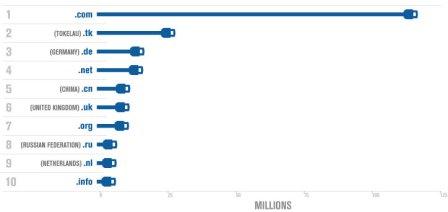
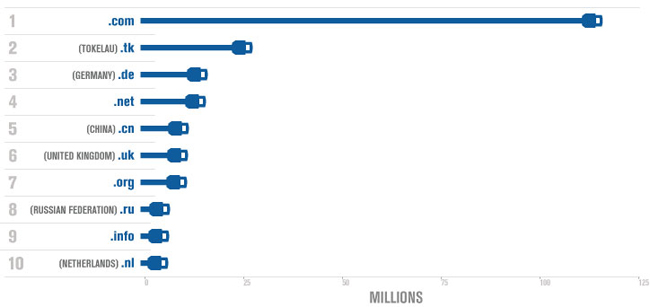
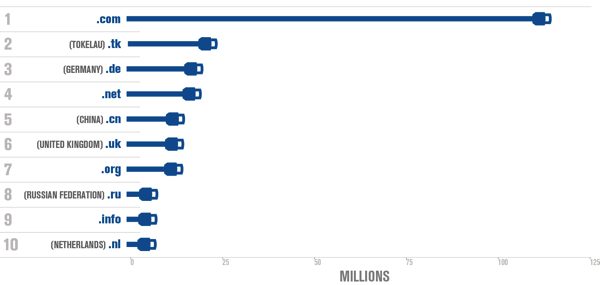
Today, we released the latest issue of the Domain Name Industry Brief, which showed that the Internet grew by four million domain names in the third quarter of 2014. The total number of domain names across all top-level domains (TLDs) is now 284 million. This is a 1.6 percent increase over the second quarter of 2014. [1]

Largest TLDs by Zone Size

TLD by Zone Size Q3 2014
Source: Zooknic, Q3 2014; Verisign, Q3 2014; Centralized Zone Data Service, Q3 2014

(more…)

Verisign OpenHybrid™: An Essential New Approach to DDoS Protection

Distributed Denial of Service (DDoS) attacks are a threat to businesses worldwide and the attacks are getting larger and more sophisticated.  The industry’s approach to protecting against DDoS attacks must change, and change fundamentally, to stay ahead of this growing threat.

For too long, the problem has been tackled piecemeal, using isolated devices or services. But protecting against DDoS attacks increasingly requires communication and coordination between many components – from networking equipment, to specialized appliances and cloud-based services.

A shift in security architecture is needed to an open platform where devices and services from different vendors can share and act on information in concert. It must be a hybrid platform, allowing on-premise routers and security appliances to detect and mitigate attacks locally, while automating alerting and switchover to cloud-based services if an attack threatens to swamp the business’ network connection.

(more…)

New from Verisign Labs: What’s in your attack surface?

Recently, Verisign Labs researcher Eric Osterweil and Verisign CSO Danny McPherson, along with Lixia Zhang, a professor of computer science at UCLA, received the Best Paper Award at this year’s IEEE Workshop on Secure Network Protocols (NPSec ‘14) for their paper, “The Shape and Size of Threats: Defining a Networked System’s Attack Surface.” Below is a guest post from one of the authors, Eric Osterweil, principal researcher for Verisign Labs, describing the genesis of the research and future plans.

(more…)

Domain Registrations: Is Bitcoin Going Mainstream?

Earlier this year we used Bitcoin as an example of how domain registrations could be an effective gauge of interest in a particular subject. Our analysis demonstrated a clear rise in the number of registered .com and .net domain names containing the term “Bitcoin” in 2013, as well as a positive correlation between increased registration activity and increases in the dollar value of bitcoin.

In this post, we decided to take a look at the history of Bitcoin-related domain registration activity since 2009 to see if we noticed any other trends.

(more…)

New from Verisign Labs: Measuring the Leakage of Onion at the Root

If you are trying to communicate anonymously on the internet using Tor, this paper may be an important read for you. Anonymity and privacy are at the core of what the Tor project promises its users. Short for The Onion Router, Tor provides individuals with a mechanism to communicate anonymously on the internet. As part of its offerings, Tor provides hidden services, specifically anonymous networking between servers that are configured to receive inbound connections only through Tor. In order to route requests to these hidden services, a namespace is used to identify the resolution requests to such services. Tor uses the .onion namespace under a non-delegated (pseudo) top-level-domain. Although the Tor system was designed to prevent .onion requests from leaking into the global DNS resolution process, numerous requests are still observed in the global DNS, causing concern about the severity of the leakage and the exposure of sensitive private data.

(more…)

New from Verisign Labs – Measuring Privacy Disclosures in URL Query Strings

Have you ever gone to socially share or email a URL and found that it was much longer than you had expected? Take the following contrived URL as an example:

http://www.example.com/path/submit.php?user=userabc&pageid=012345&utm_referrer=rss&localtime=+0500

In your personal experience, as in our example, you might have realized that the URL was as much about you, the client, as it was about the web resource you were trying to access. Indeed, internet addresses may contain a wealth of information about the identities and activities of the users visiting them. URLs often utilize query strings (i.e., key-value pairs appended to the URL path; in our example, everything after the question mark) as a means to pass session parameters and form data. While sometimes benign and necessary to render the web page, query strings often contain tracking mechanisms, user names, email addresses and other information that users may not wish to publicly reveal. In isolation this is not particularly problematic, but the growth of web 2.0 platforms such as social networks and micro-blogging means such URLs are increasingly being publicly broadcast.

(more…)