Verisign Champions Cybersecurity Awareness in October

Cybersecurity is no longer a concern for just IT and security professionals. Recent breaches at organizations like Sony, Target, JP Morgan Chase, and numerous U.S. government entities have brought the issue of cyber-attacks very close to home. If you bank online, use your debit card at a local store or engage in any activity that relies on an Internet-connected system, you are at risk.

As part of National Cyber Security Awareness Month (NCSAM), Verisign is joining with organizations and companies around the country to promote online safety and champion a safer, more secure and trusted Internet. Every week in October, we’ll share research and online safety tips from our resident cybersecurity experts via our blog and LinkedIn, Facebook and Twitter posts.

(more…)

Verisign iDefense Analysis of XcodeGhost

At Verisign we take our Internet stewardship mission very seriously, so when details emerged over the past week concerning the XcodeGhost infection, researchers at Verisign iDefense wanted to help advance community research efforts related to the XcodeGhost issue, and leveraging our unique capabilities, offer a level of public service to help readers determine their current and historical level of exposure to the infection.

Background

First identified in recent days on the Chinese microblog site Sina Weibo, XcodeGhost is an infection of Xcode, the framework developers use to create apps for Apple’s iOS and OS X operating systems. Most developers download secure Xcode from Apple. However, some acquire unofficial versions from sites with faster download speeds.
Apps created with XcodeGhost contain instructions, unknown to both the app developers and the end users, that collect potentially sensitive information from the user’s device and send it to command-and-control (C2) servers managed by the XcodeGhost operator. This way, the XcodeGhost operators circumvented the security of Apple’s official Xcode distribution, and the security of Apple’s App Store.
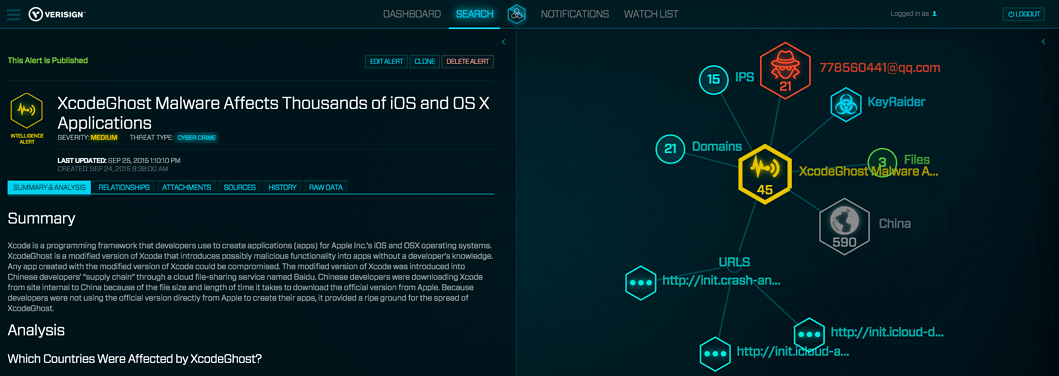
Image 1: iDefense IntelGraph chart and intelligence alert, “XcodeGhost”
The infection had widespread impact. As of September 25th, Palo Alto Networks and Fox-IT had identified more than 87 infected apps by name, and FireEye claimed to have identified more than 4,000 infected apps. This activity impacts millions of users both in China and elsewhere in the world. To understand key aspects of the infection, iDefense researchers leveraged authoritative DNS traffic patterns to the C2 domains.

(more…)

Blue Folder With Keyhole on digital background

Thinking Ahead on Privacy in the Domain Name System

Earlier this year, I wrote about a recent enhancement to privacy in the Domain Name System (DNS) called qname-minimization. Following the principle of minimum disclosure, this enhancement reduces the information content of a DNS query to the minimum necessary to get either an authoritative response from a name server, or a referral to another name server. This is some additional text.

In typical DNS deployments, queries sent to an authoritative name server originate at a recursive name server that acts on behalf of a community of users, for instance, employees at a company or subscribers at an Internet Service Provider (ISP). A recursive name server maintains a cache of previous responses, and only sends queries to an authoritative name server when it doesn’t have a recent response in its cache. As a result, DNS query traffic from a recursive name server to an authoritative name server corresponds to samples of a community’s browsing patterns. Therefore, qname-minimization may be an adequate starting point to address privacy concerns for these exchanges, both in terms of information available to outside parties and to the authoritative name server.

(more…)

Protect Your Network from BYOD Malware Threats with the Verisign DNS Firewall

Today’s new age of ubiquitous connectivity has created an insatiable and growing demand among employees and consumers to be online with familiar systems and tools at all times. Employees are no longer satisfied with the limited choices in devices and tools provided to them by their corporate IT organizations. They want to use what they want,when they want. They believe that choosing their own devices and tools provides them with the highest level of comfort and efficiency. This desire to use personal devices in work environments, referred to as “bring your own device (BYOD),” coupled with the growing cyber-attack surface, poses significant challenges to IT organizations. These challenges are leading such organizations to ask themselves – Are we ready to support BYOD?

(more…)

Introducing the Verisign DNS Firewall

Defending against cyber threats is not only critical, but increasingly difficult and expensive. Just a quick glance at today’s news headlines and it is clear that these threats present numerous challenges to Internet users and the organizations that both serve and employ them. For example, in 2014, McAfee Labs observed a 75 percent year-over-year increase in new malware equating to 387 new threats per minute. Further, the Ponemon Institute estimates the average data breach costs large organizations $3.8 million per event.

Most solutions either require extensive investment or do not meet an organization’s constantly evolving needs. Traditional, appliance-based security solutions can require organizations to shell out considerable amounts of money, both in up-front capital expenditure and in on-going maintenance fees. Conversely, many managed cloud-based offerings do not provide the critical capability to customize the solution based on an organization’s specific business environment and security needs. Finally, do-it-yourself (DIY) open-source solutions suffer from constant patching and maintenance problems.

Enter the Verisign DNS Firewall, an easy-to-configure, cost effective managed cloud-based service that offers robust protection from unwanted content, malware and advanced persistent threats (APTs), delivered with the ability to customize filtering to suit an organization’s unique needs.

(more…)

3 Key Steps for SMBs to Protect Their Website and Critical Internet Services

The National Small Business Association (NBSA) recently released a report revealing that half of all small businesses have been the victim of a cyber-attack – and the cost of dealing with these attacks has skyrocketed to $20,752 per attack. In about a third of attacks, the victim’s website was taken down, often for days. The impact of such outages cannot be measured by the immediate lost revenue alone, as the long term impact of the harm to your reputation and customer loss cannot be easily calculated.

(more…)

Verisign OpenHybrid™ for Corero and Amazon Web Services Now Available

Verisign outlined its vision for a revolutionary new approach to Distributed Denial of Service (DDoS) protection by announcing the availability of the Verisign OpenHybrid™ architecture, which helps organizations protect their critical assets and applications across distributed environments from DDoS attacks, using a single solution. By integrating intelligence from a customer’s existing security defenses, Verisign OpenHybrid™ provides timely detection and restoration of services in the event of an attack, while providing increased visibility of DDoS threats across multiple environments such as private datacenters and public clouds.

In an earlier blog post on the topic, I noted the increasing scale and complexity of DDoS attacks, and the strong need for organizations to enable awareness and mitigation of attacks across on-premise devices, in addition to both public and private cloud environments using standards based open protocols.

Today we are pleased to announce two important updates in our path toward enabling open DDoS protection: the availability of Verisign OpenHybrid™ for Corero SmartWall TDS and Verisign OpenHybrid™ for customers hosted in the Amazon Web Services Elastic Compute Cloud.

(more…)

Blue Folder With Keyhole on digital background

“What’s in a Name?” Using DANE for Authentication of Internet Services

Do we already have strong security protections for our Internet services? For many years now, we have had numerous cryptographically enhanced protocols. Standards and suites like S/MIME, Transport Layer Security (TLS), IP Security (IPSec), OpenPGP, and many others have been mature for years, have offered us a range of protections and have been implemented by a wealth of code. Indeed, based on these protections, we already count on having “secure” eCommerce transactions, secure point-to-point phone calls that our neighbors can’t listen in on, secure Virtual Private Networks (VPN) that let us remotely connect to our internal enterprise networks, etc.  However, our Internet security protocols have all excluded a very important step from their security analyses; none of them describe a crucial step called secure key learning.  That is, before we can encrypt data or verify signatures, how does someone bootstrap and learn what cryptographic keys are needed?  In lieu of a way to do this, we have traditionally prefaced the security protections from these protocols with techniques like Out of Band (OOB) key learning (learning keys in an unspecified way) or Trust on First Use (ToFU) key learning (just accepting whatever keys are found first), and each protocol must do this separately (and potentially in its own, different, way).  This is because the protocols we use for protections have not formally specified a standardized way to securely bootstrap protocols.

(more…)

Minimum Disclosure: What Information Does a Name Server Need to Do Its Job?

Two principles in computer security that help bound the impact of a security compromise are the principle of least privilege and the principle of minimum disclosure or need-to-know.

As described by Jerome Saltzer in a July 1974 Communications of the ACM article, Protection and the Control of Information Sharing in Multics, the principle of least privilege states, “Every program and every privileged user should operate using the least amount of privilege necessary to complete the job.”

Need-to-know is the counterpart for sharing information: a system component should be given just enough information to perform its role, and no more. The US Department of Health and Human services adopts this principle in the HIPAA privacy policy, for example, which states: “protected health information should not be used or disclosed when it is not necessary to satisfy a particular purpose or carry out a function.”

There may be tradeoffs, of course, between minimizing the amount of privilege or information given to a component in a system, and other objectives such as performance or simplicity. For instance, a component may be able to do its job more efficiently if given more than the minimum amount.  And it may be easier just to share more than is needed, than to extract out just the minimum required. The minimum amounts of privilege may also be hard to determine exactly, and they might change over time as the system evolves or if it is used in new ways.

Least privilege is well established in DNS through the delegation from one name server to another of just the authority it needs to handle requests within a specific subdomain. The principle of minimum disclosure has come to the forefront recently in the form of a technique called qname-minimization, which aims to improve privacy in the Domain Name System (DNS).

(more…)