Verisign Launches New gTLDs for the Korean Market, .닷컴 and .닷넷
Guest post from June Seo, Director, Verisign Naming Services Korea
Verisign is pleased to announce the launch of our phased rollout of .닷컴 and .닷넷, the localized versions of the .com and .net top-level domains (TLDs) in Hangul script for the Korean market. The Sunrise Period is open from May 16, 2016 through June 19, 2016 for .닷컴, the .com you know, now in Korean, and .닷넷, the evolution of .net for Korea.
Verisign Opens Landrush Program Period for .コム Domain Names
Guest Post from Manish Dalal, Vice President, Verisign Naming Services, Asia-Pacific
Today, the Landrush Program Period for .コム, the first IDN TLD from Verisign, opens for anyone to register .コム domain names on a first come, first served basis through June 12, 2016. The Landrush Program Period provides businesses and individuals with the opportunity to register .コム domain names before they become generally available to the public on June 13, 2016.

Increasing the Strength of the Zone Signing Key for the Root Zone
One of the most interesting and important changes to the internet’s domain name system (DNS) has been the introduction of the DNS Security Extensions (DNSSEC). These protocol extensions are designed to provide origin authentication for DNS data. In other words, when DNS data is digitally signed using DNSSEC, authenticity can be validated and any modifications detected.
A major milestone was achieved in mid-2010 when Verisign and the Internet Corporation for Assigned Names and Numbers (ICANN), in cooperation with the U.S. Department of Commerce, successfully deployed DNSSEC for the root zone. Following that point in time, it became possible for DNS resolvers and applications to validate signed DNS records using a single root zone trust anchor.
DNSSEC works by forming a chain-of-trust between the root (i.e., the aforementioned trust anchor) and a leaf node. If every node between the root and the leaf is properly signed, the leaf data is validated. However, as is generally the case with digital (and even physical) security, the chain is only as strong as its weakest link.
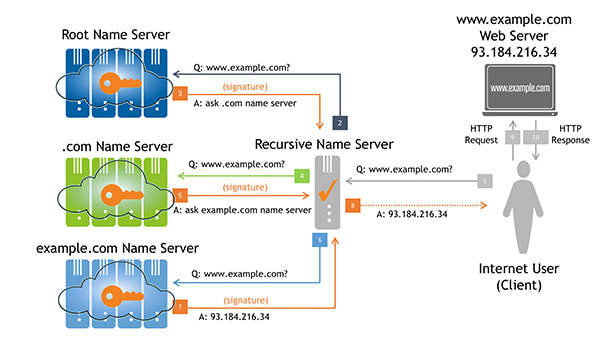
To strengthen the chain at the top of the DNS, Verisign is working to increase the strength of the root zone’s Zone Signing Key (ZSK), which is currently 1024-bit RSA, and will sign the root zone with 2048-bit RSA keys beginning Oct. 1, 2016.

Internet Grows to 314 Million Domain Names in the Fourth Quarter of 2015
Today, we released the latest issue of the Domain Name Industry Brief, which showed that the Internet grew by approximately 15 million domain names in the fourth quarter of 2015, and closed with a base of 314 million domain names across all top-level domains (TLDs). That’s a 5 percent increase over the third quarter of 2015. [1]

Verisign Q4 2015 DDoS Trends: Attack Activity Increases 85 Percent Year Over Year
Verisign just released its Q4 2015 DDoS Trends Report, which provides a unique view into online distributed denial of service (DDoS) attack trends from mitigations enacted on behalf of customers of Verisign DDoS Protection Services and research conducted by Verisign iDefense Security Intelligence Services.
Every industry is at risk as DDoS attacks continue to increase in size, sophistication and frequency. The most notable observation last quarter is the increase in DDoS attack activity, which was at its highest since the inception of Verisign’s DDoS Trends Report in Q1 2014. Comparing year-over-year attack activity, Verisign mitigated 85 percent more attacks in Q4 2015 than in Q4 2014. Some customers were hit with persistent, repeated attacks over the quarter.

Priority Access Program for Verisign’s First IDN New gTLD, .コム
Guest post from Manish Dalal, Vice President, Verisign Naming Services Asia
Verisign launched its first IDN new gTLD, .コム – the .com you know, now in Japanese – on Dec. 9, 2015 at 12:00 a.m. UTC. We recently submitted updated TLD Startup Information for .コム to ICANN, extending the end date for the .コム Sunrise Period from Jan. 31, 2016, to March 14, 2016, and shifting the dates of the subsequent registration periods. ICANN recently confirmed the following updated registration periods for the .コム TLD*:
Sunrise Period: Dec. 9, 2015 – March 14, 2016
Priority Access Program Period: March 15 – May 15, 2016
Landrush Program Period: May 16 – June 12, 2016
General Registration Period: Start Date June 13, 2016
Trademark Claims Period: June 13 – Sept. 11, 2016
The Internet Grew to 299 Million Domain Names in the Third Quarter of 2015
Today, we released the latest issue of the Domain Name Industry Brief, which showed that the Internet grew by approximately 3.1 million domain names in the third quarter of 2015, and closed with a base of 299 million domain names across all top-level domains (TLDs). This is a 1.1 percent increase over the second quarter of 2015.

Verisign’s Perspective on Recent Root Server Attacks
On Nov. 30 and Dec. 1, 2015, some of the Internet’s Domain Name System (DNS) root name servers received large amounts of anomalous traffic. Last week the root server operators published a report on the incident. In the interest of further transparency, I’d like to take this opportunity to share Verisign’s perspective, including how we identify, handle and react, as necessary, to events such as this.

Launch of Verisign’s First IDN New gTLD, .コム
Guest post from Manish Dalal, Vice President, Verisign Naming Services Asia
The composition of the Internet’s population continues to evolve toward a more localized Web. Asia has been leading the way forward as the populations in that region come online and begin creating and consuming content in their local languages. According to Internet World Stats, over 48 percent of all Internet users are located in Asia and, according to W3Techs, approximately 45 percent of all websites in the world are in a language other than English.
Still, navigation of the Internet through a URL is primarily in English. Therefore, by enabling more end users to navigate the Internet in scripts representing their native language, and giving more companies the ability to maintain a common brand identity across many scripts, Internationalized Domain Names (IDNs) have the potential to make the Internet more accessible and thus more usable to end users around the world. This accessibility is why IDNs have generated considerable attention since Verisign introduced IDNs at the second-level in 2000.

In Network Security Design, It’s About the Users
One of the longstanding goals of network security design is to be able to prove that a system – any system – is secure.
Designers would like to be able to show that a system, properly implemented and operated, meets its objectives for confidentiality, integrity, availability and other attributes against the variety of threats the system may encounter.
A half century into the computing revolution, this goal remains elusive.
One reason for the shortcoming is theoretical: Computer scientists have made limited progress in proving lower bounds for the difficulty of solving the specific mathematical problems underlying most of today’s cryptography. Although those problems are widely believed to be hard, there’s no assurance that they must be so – and indeed it turns out that some of them may be quite easy to solve given the availability of a full-scale quantum computer.
Another reason is a quite practical one: Even given building blocks that offer a high level of security, designers, as well as implementers, may well put them together in unexpected ways that ultimately undermine the very goals they were supposed to achieve.