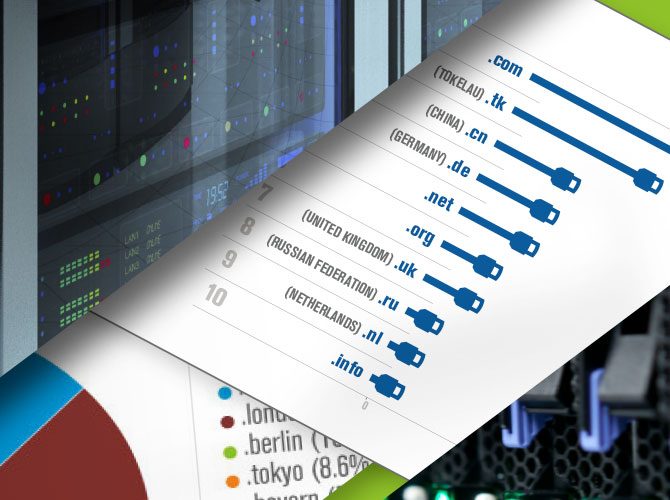
Internet Grows to 296 Million Domain Names in Second Quarter of 2015
Today, we released the latest issue of the Domain Name Industry Brief, which showed that the Internet grew by two million domain names in the second quarter of 2015, and closed with a base of 296 million domain names across all top-level domains (TLDs). This is a 0.8 percent increase over the first quarter of 2015.[1]

Protect Your Network from BYOD Malware Threats with the Verisign DNS Firewall
Today’s new age of ubiquitous connectivity has created an insatiable and growing demand among employees and consumers to be online with familiar systems and tools at all times. Employees are no longer satisfied with the limited choices in devices and tools provided to them by their corporate IT organizations. They want to use what they want,when they want. They believe that choosing their own devices and tools provides them with the highest level of comfort and efficiency. This desire to use personal devices in work environments, referred to as “bring your own device (BYOD),” coupled with the growing cyber-attack surface, poses significant challenges to IT organizations. These challenges are leading such organizations to ask themselves – Are we ready to support BYOD?

Happy Anniversary .Net
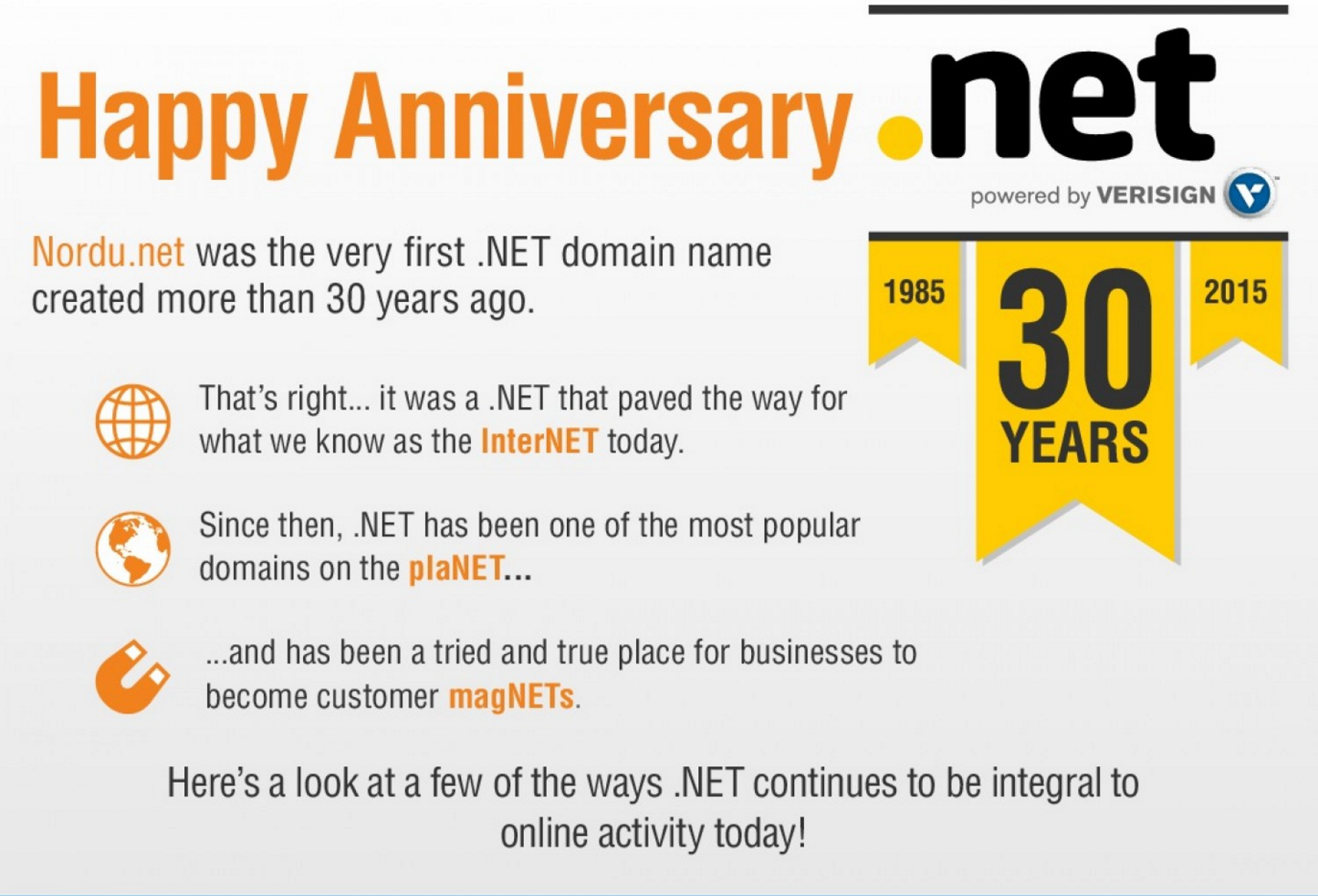
For the last 30 years, .net has been one of the most popular domain name extensions on the planet. It is responsible for millions of thriving online businesses and countless intersections of communication, education and entertainment. It is where the very first domain name ever created, Nordu.net, made its home online, and is now home to approximately 15 million domain names.
Take a look at the infographic below to see a few more ways .net continues to be integral to online activity and find yourself a memorable .net domain name today at www.Verisign.net/net.
Introducing the Verisign DNS Firewall
Defending against cyber threats is not only critical, but increasingly difficult and expensive. Just a quick glance at today’s news headlines and it is clear that these threats present numerous challenges to Internet users and the organizations that both serve and employ them. For example, in 2014, McAfee Labs observed a 75 percent year-over-year increase in new malware equating to 387 new threats per minute. Further, the Ponemon Institute estimates the average data breach costs large organizations $3.8 million per event.
Most solutions either require extensive investment or do not meet an organization’s constantly evolving needs. Traditional, appliance-based security solutions can require organizations to shell out considerable amounts of money, both in up-front capital expenditure and in on-going maintenance fees. Conversely, many managed cloud-based offerings do not provide the critical capability to customize the solution based on an organization’s specific business environment and security needs. Finally, do-it-yourself (DIY) open-source solutions suffer from constant patching and maintenance problems.
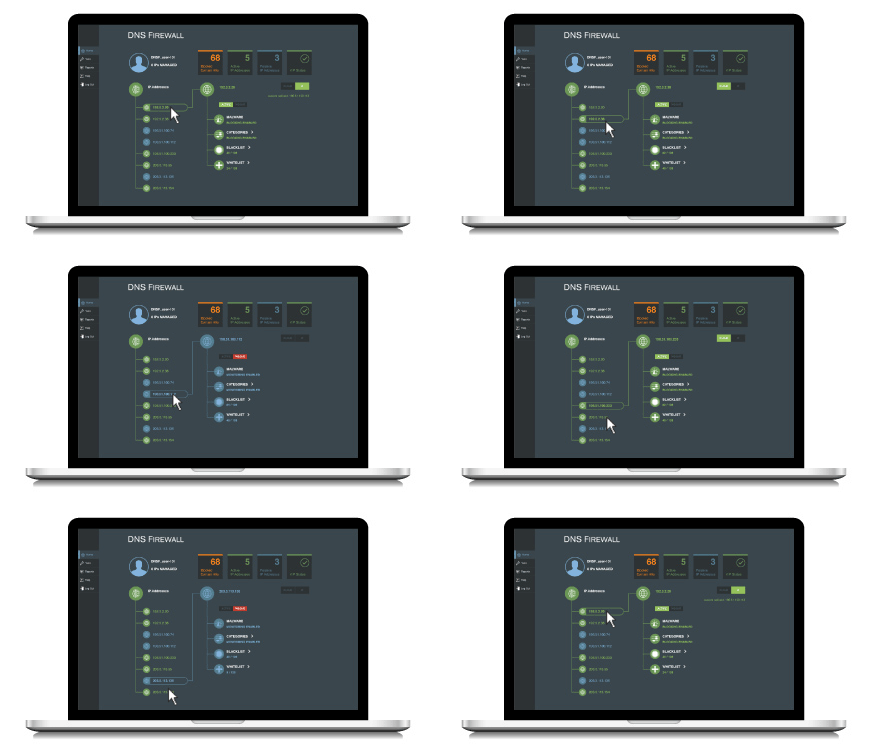
Enter the Verisign DNS Firewall, an easy-to-configure, cost effective managed cloud-based service that offers robust protection from unwanted content, malware and advanced persistent threats (APTs), delivered with the ability to customize filtering to suit an organization’s unique needs.
Internet Grows to 294 Million Domain Names in the First Quarter of 2015
Today, we released the latest issue of the Domain Name Industry Brief, which showed that the Internet grew by six million domain names in the first quarter of 2015, and closed with a base of 294 million domain names across all top-level domains (TLDs). This is a 1.9 percent increase over the fourth quarter of 2014.[1]

Verisign Named to the Online Trust Alliance’s 2015 Honor Roll
 Verisign is excited to announce that we made the Online Trust Alliance’s (OTA) 2015 Honor Roll for showing a commitment to best practices in security, privacy and consumer protection. This is the third consecutive year that Verisign has received this honor.

3 Key Steps for SMBs to Protect Their Website and Critical Internet Services
The National Small Business Association (NBSA) recently released a report revealing that half of all small businesses have been the victim of a cyber-attack – and the cost of dealing with these attacks has skyrocketed to $20,752 per attack. In about a third of attacks, the victim’s website was taken down, often for days. The impact of such outages cannot be measured by the immediate lost revenue alone, as the long term impact of the harm to your reputation and customer loss cannot be easily calculated.

How Will Your Registration Data Be Managed in the Future?
Benjamin Franklin once said, “By failing to prepare, you are preparing to fail.” As we consider how Internet domain and address registration data is managed and accessed in a post-WHOIS era, and given the long history of failure in addressing the shortcomings of WHOIS, it is extremely important to start preparing now for the eventual replacement of WHOIS. This is the fundamental purpose of the next Registration Operations Workshop (ROW) that is scheduled for Sunday, July 19, 2015, in Prague, Czech Republic.
ROW 2015-2 will take place at the Hilton Prague hotel, the same venue as the 93rd meeting of the Internet Engineering Task Force (IETF-93). The workshop will be dedicated to discussion and planning for development and testing deployments of the Registration Data Access Protocol (RDAP), a recent work product of the IETF that is documented in Request For Comments (RFC) documents 7480, 7481, 7482, 7483, and 7484. RDAP was designed from the beginning to address the many shortcomings of WHOIS, but we have very little experience with early-stage implementations that can be used to inform the policy decisions that need to be made. Additional information about WHOIS and RDAP can be found in my “Where Do Old Protocols Go To Die?” blog post published earlier this year. (more…)
Verisign OpenHybrid™ for Corero and Amazon Web Services Now Available
Verisign outlined its vision for a revolutionary new approach to Distributed Denial of Service (DDoS) protection by announcing the availability of the Verisign OpenHybrid™ architecture, which helps organizations protect their critical assets and applications across distributed environments from DDoS attacks, using a single solution. By integrating intelligence from a customer’s existing security defenses, Verisign OpenHybrid™ provides timely detection and restoration of services in the event of an attack, while providing increased visibility of DDoS threats across multiple environments such as private datacenters and public clouds.
In an earlier blog post on the topic, I noted the increasing scale and complexity of DDoS attacks, and the strong need for organizations to enable awareness and mitigation of attacks across on-premise devices, in addition to both public and private cloud environments using standards based open protocols.
Today we are pleased to announce two important updates in our path toward enabling open DDoS protection: the availability of Verisign OpenHybrid™ for Corero SmartWall TDS and Verisign OpenHybrid™ for customers hosted in the Amazon Web Services Elastic Compute Cloud.

Registration Operations is More Than Just Registering Domain Names
Perceptions can be difficult to change. People see the world through the lens of their own experiences and desires, and new ideas can be difficult to assimilate. Such is the case with the registration ecosystem. Today’s operational models exist because of decisions made over time, but the assumptions that were used to support those decisions can (and should) be continuously challenged to ensure that they are addressing today’s realities. Are we ready to challenge assumptions? Can the operators of registration services do things differently?