
What’s Really New in the New gTLD Space?
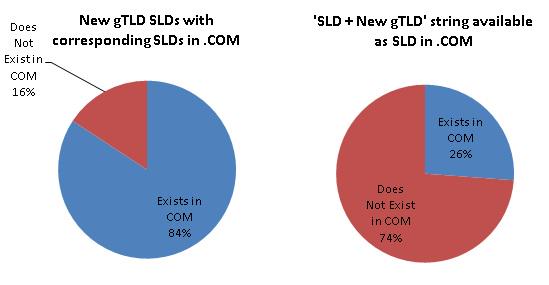
As someone who has long studied trends in the domain name industry, the opening of hundreds of new gTLDs has intrigued me for quite some time on many levels. One question I found myself pondering was: Will new gTLDs create “new” naming trends or redundant domains across many TLDs? With more than 3 million domains delegated in the new TLD space there is now a corpus to study to answer this question.
The short answer is clear from these first two pie charts which illustrate the percentage of the second-level domains (SLDs) that were available in .com as of 12/15/2014:

New from Verisign Labs: What’s in your attack surface?
 Recently, Verisign Labs researcher Eric Osterweil and Verisign CSO Danny McPherson, along with Lixia Zhang, a professor of computer science at UCLA, received the Best Paper Award at this year’s IEEE Workshop on Secure Network Protocols (NPSec ‘14) for their paper, “The Shape and Size of Threats: Defining a Networked System’s Attack Surface.” Below is a guest post from one of the authors, Eric Osterweil, principal researcher for Verisign Labs, describing the genesis of the research and future plans.
Domain Registrations: Is Bitcoin Going Mainstream?
Earlier this year we used Bitcoin as an example of how domain registrations could be an effective gauge of interest in a particular subject. Our analysis demonstrated a clear rise in the number of registered .com and .net domain names containing the term “Bitcoin” in 2013, as well as a positive correlation between increased registration activity and increases in the dollar value of bitcoin.
In this post, we decided to take a look at the history of Bitcoin-related domain registration activity since 2009 to see if we noticed any other trends.

Internet Grows to 280 Million Domain Names in the Second Quarter of 2014
Today, we released the latest issue of the Domain Name Industry Brief, which showed that the Internet grew by four million domain names in the second quarter of 2014. The total number of domain names across all top-level domains (TLDs) is now 280 million. This is a 1.4 percent increase over the first quarter of 2014. [1]

Summary of the Registration Operations Association Workshop
The first Registration Operations Association Workshop took place on Thursday, October 16, 2014, at the Los Angeles Hyatt Regency Century Plaza Hotel. I’d like to thank the 64 people that took the time to attend and participate in the discussion, both in-person and remote.
I started the workshop with an introduction to some of the technical challenges being faced by the domain registration industry. Additional challenges were described by Thomas Stocking of Gandi.net, Tobias Sattler of United Domains and Peter Larsen of Larsen Data ApS, and James Gould of Verisign. After discussing the challenges, we had an opportunity to consider proposals for organization presented by John Levine of Standcore LLC, Thomas Rickert of eco, and Adam Newman of IEEE-ISTO. The remainder of the morning was spent discussing those proposals and other options for creating a forum in which all interested members of our community could meet for face-to-face discussions. I’m very happy to report that we reached consensus on an approach.
New from Verisign Labs: Measuring IPv6 Adoption
IPv4 is the common thread that has held the internet together since its very early years, and, thus, it is both the most
important and most widely deployed networking protocol in existence. As the world rapidly runs out of available IPv4 address space, there has been a major movement to transition the internet to the IPv6 protocol with its vastly larger address space.
The global internet community has shown a huge level of collaborative effort in driving this transition. Events like World IPv6 Day and World IPv6 Launch Day brought together organizations working across all levels of network connectivity to raise awareness of the ever-increasing need for this change. Held on Feb. 11, 2011, World IPv6 Day marked the beginning of the changeover process. Since then, IPv6 adoption has been a closely watched and increasingly important metric.

Registration Operations Association Workshop Update
In a series of recent blog posts I’ve described the technical challenges in registration operations, a proposal for an industry association, and announced an interactive workshop to explore association formation. This is an update on where things stand with the workshop.
The first Registration Operations Association Workshop is scheduled for Thursday, October 16, 2014 in the Pacific Palisades room at the Los Angeles Hyatt Regency Century Plaza hotel, the same venue being used for ICANN 51. The event is not affiliated with ICANN, but with ICANN’s support we’ve been able to secure a room that’s large enough to seat more than 100 people. Still, space is limited and seats are going fast. Please register quickly if you haven’t already done so. Registered attendees will receive updates via email as we get closer to the event date.

Exploring Future Internet Architectures
UCLA and Washington University in St. Louis recently announced the launch of the Named Data Networking (NDN) Consortium, a new forum for collaboration among university and industry researchers, including Verisign, on one candidate next-generation information-centric architecture for the internet.
Verisign Labs has been collaborating with UCLA Professor Lixia Zhang, one of the consortium’s co-leaders, on this future-directed design as part our university research program for some time. The consortium launch is a natural next step in facilitating this research and its eventual application.
Van Jacobson, an Internet Hall of Fame member and the other co-leader of the NDN Consortium, surveyed developments in this area in his October 2012 talk in the Verisign Labs Distinguished Speaker Series titled, “The Future of the Internet? Content-Centric Networking.”
As I stated in my summary of the talk, content-centric networking and related research areas under the heading of information-centric networking and NDN bring internet protocols up to date to match the way many of us already are using the internet. As Van noted, when people want to access content over the internet– for instance the recording of his talk – they typically reference a URL, for instance http://www.youtube.com/watch?v=3zOLrQJ5kbU.

New from Verisign Labs: Measuring the Leakage of Onion at the Root
If you are trying to communicate anonymously on the internet using Tor, this paper may be an important read for you. Anonymity and privacy are at the core of what the Tor project promises its users. Short for The Onion Router, Tor provides individuals with a mechanism to communicate anonymously on the internet. As part of its offerings, Tor provides hidden services, specifically anonymous networking between servers that are configured to receive inbound connections only through Tor. In order to route requests to these hidden services, a namespace is used to identify the resolution requests to such services. Tor uses the .onion namespace under a non-delegated (pseudo) top-level-domain. Although the Tor system was designed to prevent .onion requests from leaking into the global DNS resolution process, numerous requests are still observed in the global DNS, causing concern about the severity of the leakage and the exposure of sensitive private data.

Is it Time for a Registration Operations Industry Association? Part III
In Parts I and II of this series of blog posts I described the need for a registration operations industry association. At the end of Part II, I wrote that Part III will describe “an opportunity for everyone that’s interested in discussing this topic in a live environment.” The large number of people attending ICANN 51 in Los Angeles presents the best chance of discussion with many potential participants being in the same place at the same time. Let’s take advantage of that proximity.
Verisign will host a workshop for all interested people during the week of ICANN 51. The event will be held at the Hyatt Regency Century Plaza hotel (the same venue for ICANN 51, though this event is not affiliated with ICANN) on the morning of Thursday, October 16, 2014, to discuss the challenges of registration technical operations and to explore ways to address those challenges. We’ve set up a website at www.regiops.net to provide information, describe the event, and allow people to register. We’re asking people to register in advance so we can make sure that we have a large enough room reserved and that we provide enough food for breakfast and lunch.