Verisign iDefense Analysis of XcodeGhost

At Verisign we take our Internet stewardship mission very seriously, so when details emerged over the past week concerning the XcodeGhost infection, researchers at Verisign iDefense wanted to help advance community research efforts related to the XcodeGhost issue, and leveraging our unique capabilities, offer a level of public service to help readers determine their current and historical level of exposure to the infection.

Background

First identified in recent days on the Chinese microblog site Sina Weibo, XcodeGhost is an infection of Xcode, the framework developers use to create apps for Apple’s iOS and OS X operating systems. Most developers download secure Xcode from Apple. However, some acquire unofficial versions from sites with faster download speeds.
Apps created with XcodeGhost contain instructions, unknown to both the app developers and the end users, that collect potentially sensitive information from the user’s device and send it to command-and-control (C2) servers managed by the XcodeGhost operator. This way, the XcodeGhost operators circumvented the security of Apple’s official Xcode distribution, and the security of Apple’s App Store.
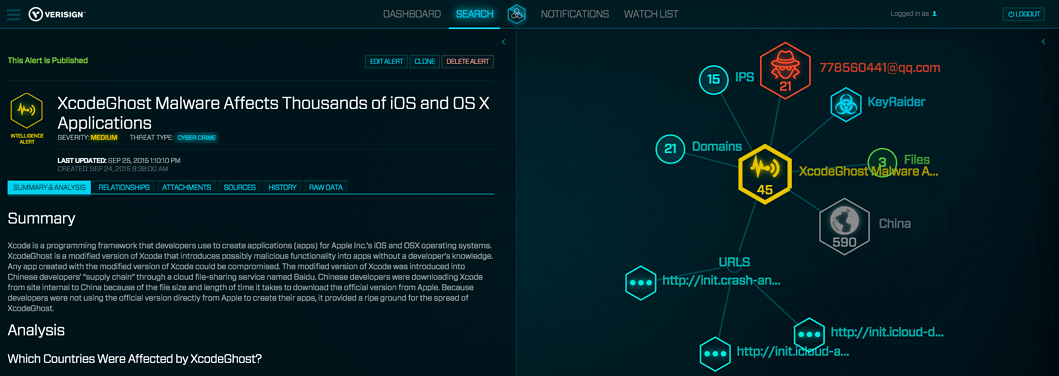
Image 1: iDefense IntelGraph chart and intelligence alert, “XcodeGhost”
The infection had widespread impact. As of September 25th, Palo Alto Networks and Fox-IT had identified more than 87 infected apps by name, and FireEye claimed to have identified more than 4,000 infected apps. This activity impacts millions of users both in China and elsewhere in the world. To understand key aspects of the infection, iDefense researchers leveraged authoritative DNS traffic patterns to the C2 domains.


(more…)

Verisign OpenHybrid™ for Corero and Amazon Web Services Now Available

Verisign outlined its vision for a revolutionary new approach to Distributed Denial of Service (DDoS) protection by announcing the availability of the Verisign OpenHybrid™ architecture, which helps organizations protect their critical assets and applications across distributed environments from DDoS attacks, using a single solution. By integrating intelligence from a customer’s existing security defenses, Verisign OpenHybrid™ provides timely detection and restoration of services in the event of an attack, while providing increased visibility of DDoS threats across multiple environments such as private datacenters and public clouds.

In an earlier blog post on the topic, I noted the increasing scale and complexity of DDoS attacks, and the strong need for organizations to enable awareness and mitigation of attacks across on-premise devices, in addition to both public and private cloud environments using standards based open protocols.

Today we are pleased to announce two important updates in our path toward enabling open DDoS protection: the availability of Verisign OpenHybrid™ for Corero SmartWall TDS and Verisign OpenHybrid™ for customers hosted in the Amazon Web Services Elastic Compute Cloud.

(more…)

Almost Half of Companies Lack DDoS Response Plans

It’s tempting to see the threat of distributed denial of service (DDoS) as noise in the background of cybersecurity discussions, but don’t be fooled. Any risk to your critical web infrastructure can have a severe impact to your business, and given that the frequency, scale and sophistication of these types of attacks are increasing, the threat is very real.

(more…)

Pioneering Technologies for the Long Term

We recently hosted Dr. Ralph Merkle as a guest speaker for the Verisign Labs Distinguished Speaker Series. His talk, “Quantum Computers and Public-Key Cryptosystems,” was a great presentation on how molecular nanotechnology — the ability to economically manufacture most arrangements of atoms permitted by physical law — could fundamentally alter the world as we know it. Ralph’s and many others’ research on this topic has been groundbreaking and we are grateful he took the time to come and share his knowledge.

(more…)